
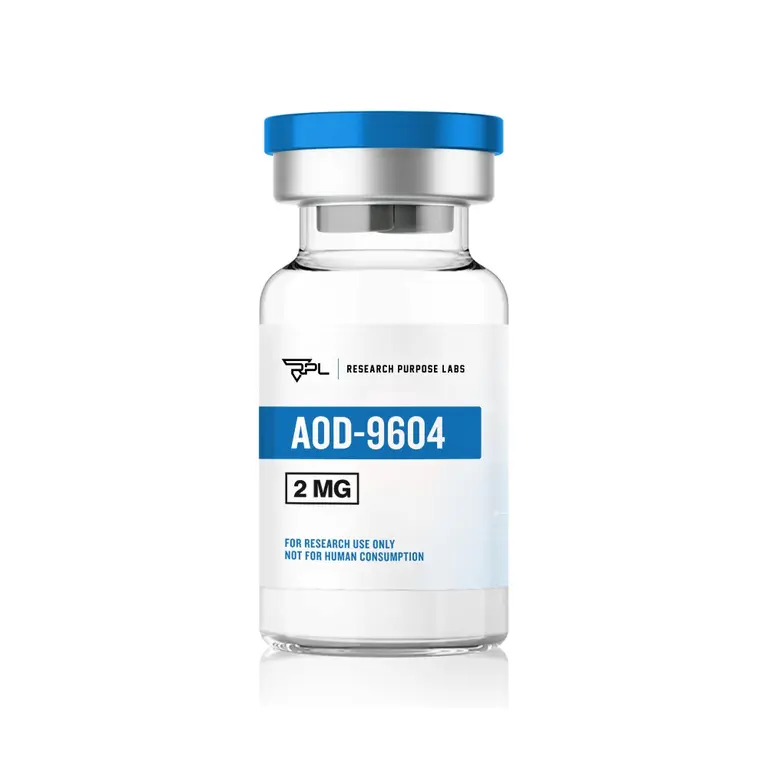
Peptides materials offered for laboratory research may be accompanied by product specifications, laboratory documentation, research references, storage information, and intended-use statements. For researchers, reviewing these materials can take time, and different documents may answer different questions.
At Research Purpose Labs, the focus is on making research-related product information for online peptides accessible and easier to review. Looking at specifications, testing records, batch information, intended use, and relevant supporting information together can provide additional context and help researchers distinguish documented details from matters requiring further investigation.
Key Takeaways
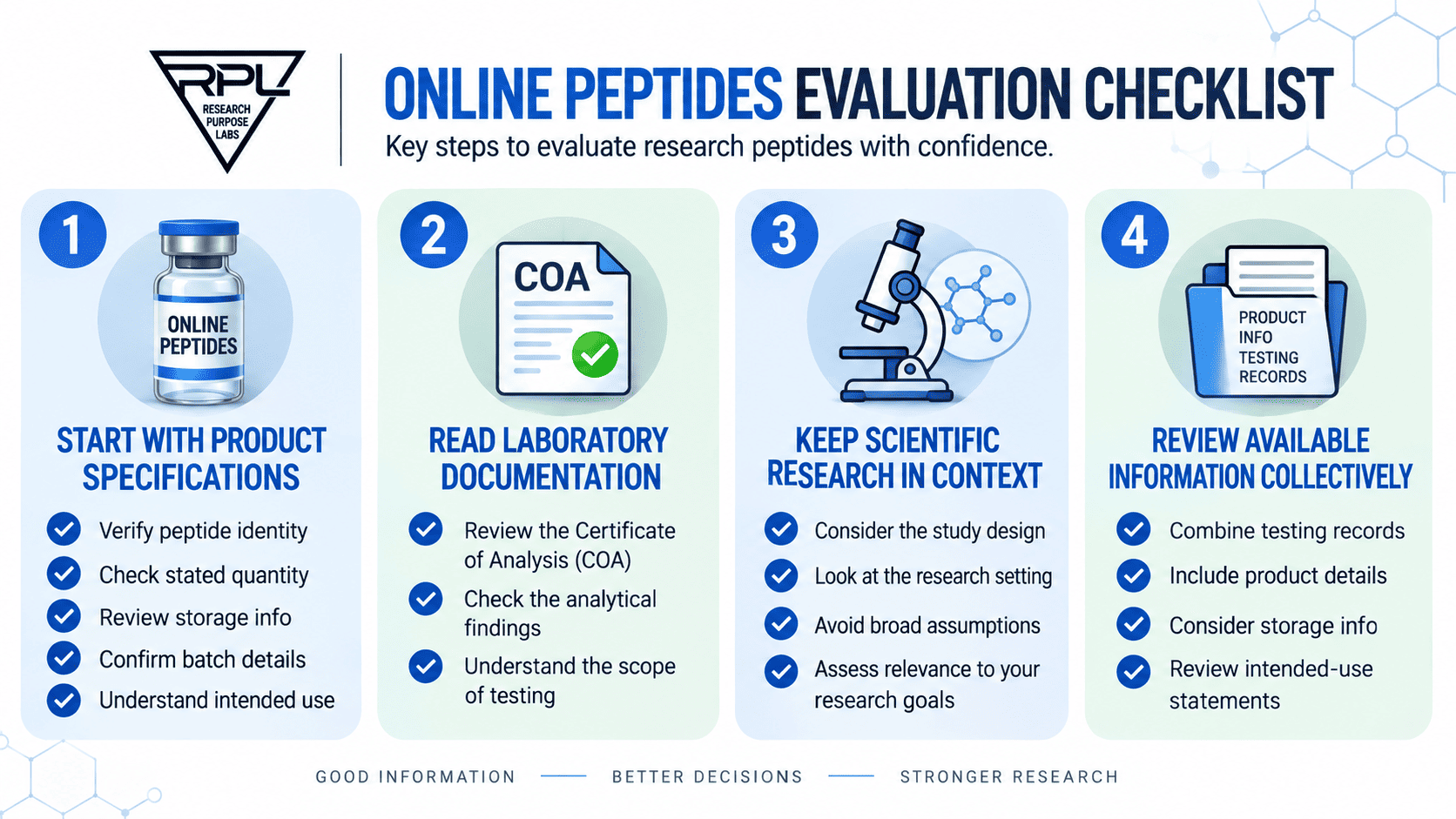
- Start with the product specifications. Online Peptides identity, stated quantity, storage information, batch details, and intended use provide a practical starting point for evaluating research materials.
- Read laboratory documentation carefully. A certificate of analysis (COA) can provide analytical findings, but those findings should be interpreted only within the scope of the testing performed.
- Keep scientific research in context. Findings from a particular study or experimental setting should not automatically be assumed to apply under different conditions or applications.
- Review available information collectively. Testing records, product details, storage information, and intended-use statements can provide different forms of information for researchers to assess.
Contact Us Today!
Start With the Product Specifications
Before reviewing studies or technical documents, begin with the basic product information.
Useful details may include the peptide name, stated quantity or concentration, formulation information, storage recommendations, batch or lot identification, and intended use. These specifications establish a baseline for reviewing other documentation.
Clarity matters. A detailed product page gives researchers information they can compare with supporting materials. If important specifications are missing, additional investigation may be appropriate.
Consistency is also worth checking. When a product page and supporting documents refer to the same batch or material, researchers can compare identifying information across those resources.
Take a Closer Look at Laboratory Documentation
Testing documents can provide analytical information about a peptide sample. Depending on the methods used, testing may report findings concerning identity, purity, composition, or other measurable characteristics.
One document researchers may encounter is a certificate of analysis, commonly abbreviated as COA.
Rather than simply confirming that a COA exists, researchers can review what it actually reports, including the product or batch tested, testing date, analytical methods, laboratory information, and reported findings where provided on online peptides.
It is equally important to understand the document’s limitations.
A purity result, for example, provides information concerning a tested sample using a particular analytical method. That finding does not automatically establish characteristics outside the scope of the analysis. A COA should not be treated as evidence of medical effectiveness, safety for personal use, or outcomes beyond the testing performed.
Compare Information From More Than One Source
A single document rarely provides every piece of information relevant to evaluating a peptide material. Different sources serve different purposes.
A product page describes how a supplier presents a material. A COA provides findings associated with analytical testing. Scientific publications investigate defined research questions. Institutional and regulatory resources may provide additional context concerning standards or requirements.
Reviewing these sources can help researchers identify where information is consistent and where additional questions remain.
Researchers can compare identifying details on a product page with those shown in relevant analytical documentation. Relevant scientific literature may provide additional research context, provided that the underlying study is accurately characterized and relevant to the specific question being considered.
These sources should not be treated as interchangeable. Each has a different purpose and should be interpreted accordingly.
Read Scientific References With Context in Mind
Scientific terminology can sound authoritative, but study design and methodology matter.
When peptide-related information references a publication, laboratory study, or case report, researchers should consider the original source whenever possible and examine what was actually studied.
Relevant considerations may include study design, sample size, methodology, experimental conditions, publication source, research model, and independent reproduction.
An observation reported under narrowly controlled experimental conditions may be relevant to those conditions but should not automatically be generalized to unrelated settings.
Case reports require similar care. An observation reported in an individual case describes what occurred in that particular context and does not establish that the same outcome should be expected elsewhere.
Keeping research findings within their original scope supports more accurate interpretation.
Check for Transparency and Consistency
Transparency involves reviewing available information as a whole rather than relying on a single document.
Researchers can examine whether a supplier provides clear product identification, testing information, storage recommendations, handling details, intended-use statements, and a means of requesting additional information where necessary.
Consistency can also be evaluated. If a COA is associated with a particular batch, researchers can compare its identifying information with relevant product documentation. Storage details and intended-use statements can also be reviewed across available materials.
No single document establishes every characteristic of a material. Reviewing available records collectively can provide researchers with additional information to evaluate.
Don’t Overlook Storage and Handling Details
Storage information is part of understanding how a product is represented.
Different materials may have different storage recommendations. Researchers should review information associated with the specific peptide rather than assuming that guidance for one material applies to another.
Laboratories may also maintain established procedures for receiving, documenting, storing, and handling research materials. Supplier information should be considered alongside applicable institutional requirements.
Understand Why Intended Use Matters
Peptides can appear in different scientific, laboratory, commercial, and regulatory contexts, and those settings should not be treated as interchangeable.
If a product is presented for laboratory research, the accompanying information should be evaluated within that stated context. Research documentation should not automatically be interpreted as guidance for personal or medical applications.
The same principle applies to scientific findings. A result observed in one research environment does not automatically establish what might occur in another setting.
Requirements may vary by jurisdiction, institution, product, and intended application. Researchers should consider applicable regulations, institutional policies, and professional standards when evaluating materials for a project.
Online product information is not a substitute for medical guidance. Questions involving diagnosis, treatment, personal use, or individual health decisions should be discussed with an appropriately qualified healthcare professional.
Build a Consistent Review Process
Researchers can develop a consistent set of questions when reviewing peptide materials.
Online Peptides begin with product identification and specifications. Check the intended use and storage information. Review available analytical documentation and determine what the testing actually covered. Then consult relevant scientific, institutional, or regulatory resources when additional context is necessary.
If information does not align across available materials, further investigation may be appropriate rather than filling gaps with assumptions.
A repeatable process can make documentation review more efficient while keeping the focus on information that can actually be examined.
Contact Us Today!
Reach Out to Research Purpose Labs Today
Explore Research Purpose Labs for information on available materials, product specifications, testing documentation, and research-related resources on online peptides.
Researchers evaluating materials for a laboratory project can review each product’s stated intended use and available documentation alongside applicable institutional procedures, professional standards, and regulatory requirements.
Frequently Asked Questions
Q: What should researchers check first when reviewing peptide materials?
A: Online Peptides start with basic product information, including peptide identity, stated quantity or concentration, intended use, storage recommendations, and batch details. These specifications provide a foundation for reviewing supporting documentation.
Q: What information does a certificate of analysis provide?
A: A COA reports analytical findings associated with a tested sample or batch. What the document can establish depends on the analytical methods used and the information reported by the laboratory.
Q: Does a COA establish that a peptide is suitable for every research application?
A: No. A COA provides information within the scope of the testing performed. Researchers still need to determine whether the material and available documentation are appropriate for their specific research requirements.
Q: Why should researchers use more than one source?
A: Different sources provide different forms of information. Product specifications, laboratory testing, scientific literature, and institutional or regulatory resources can provide complementary context when evaluated appropriately.
Q: How should scientific studies about peptides be interpreted?
A: Researchers should consider the study design, methodology, sample size, experimental conditions, research model, endpoints, and publication source. Findings should remain within the context in which they were observed rather than being generalized automatically.
Q: Why is intended use important when evaluating peptide materials?
A: Intended use establishes the context in which a product is presented. Information associated with laboratory research should not automatically be interpreted as guidance for medical, cosmetic, personal, or other unrelated applications.

No comment