
Searching for peptides for sale online USA can give researchers access to a wide range of product listings, supplier information, and research materials. The number of available options, however, can make it difficult to determine which information deserves attention during the sourcing process.
Instead of starting with price or product presentation, laboratories can establish a procurement checklist based on the requirements of the research project. Product identity, available documentation, intended use, storage considerations, and institutional procedures can all become part of a consistent evaluation process.
At Research Purpose Labs, we believe research sourcing begins with understanding what a project requires. This guide explores how laboratories can build a practical framework for reviewing peptide materials and supplier information.
Key Takeaways
- Define procurement requirements before searching. Establish the material, specifications, and documentation relevant to the research project before comparing products. A predefined framework can make supplier evaluations more consistent.
- Review documentation in the correct context. Product specifications, batch information, and other available records can provide different types of information about research materials. Researchers should consider what each document actually addresses rather than relying on a single record.
- Include laboratory procedures in sourcing decisions. Receiving, storage, handling, and recordkeeping requirements can affect how research materials are managed. Reviewing these procedures beforehand can help laboratories prepare for incoming materials.
- Keep the stated research context clear. Peptide materials presented for laboratory research should be evaluated within that intended-use context. Research product information should not be interpreted as guidance for personal or medical use.
Contact Us Today!
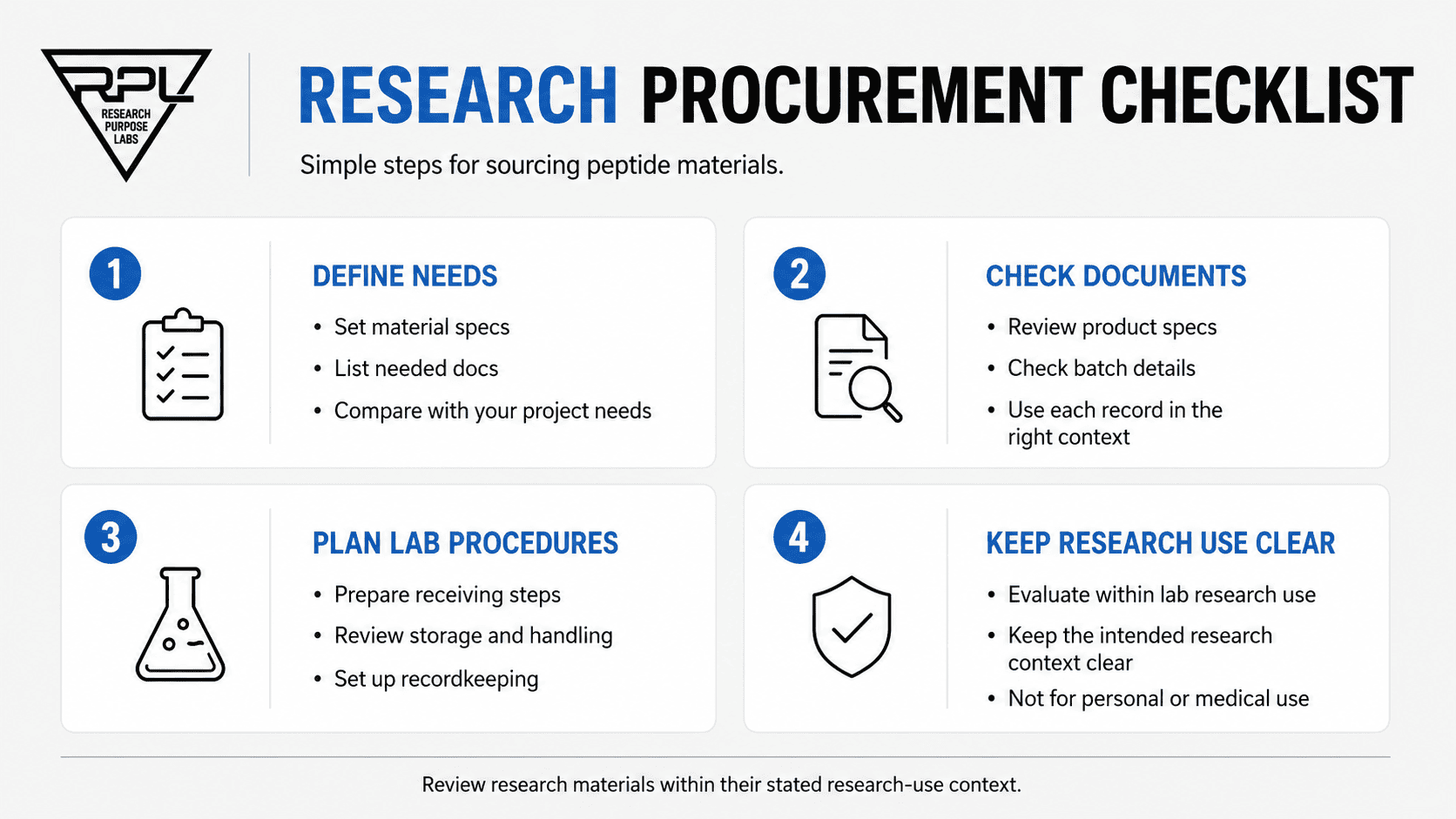
Build Your Checklist Before Browsing Products
One way to make online sourcing more manageable is to decide what information matters before reviewing individual products.
Researchers can begin with the research protocol and identify the exact material required. From there, they can establish criteria relevant to the project, laboratory, and institution.
This approach changes the sourcing question. Rather than asking which product listing appears most attractive, researchers can ask whether each prospective material provides the information required for their particular research process.
When searching for peptides for sale online USA, predefined criteria can be especially useful because suppliers may organize and describe their materials differently.
A laboratory’s checklist might address product identity, specifications, intended use, documentation, storage information, supplier policies, and internal procurement requirements.
The appropriate checklist will depend on the individual research setting.
Confirm Product Identity First
The name displayed on a product page is a starting point, but laboratories may need additional identifying information depending on their protocol.
Researchers should compare the material being offered with the material specified for their project. Where additional product specifications are relevant, those details can become part of the evaluation.
Maintaining consistent criteria is important when comparing similar listings across suppliers. Researchers can review each prospective material against the same project requirements rather than changing standards based on how individual products are marketed.
This keeps the sourcing process centered on the research protocol.
Decide Which Product Information Matters
Not every piece of information on a product page has equal relevance to every research project.
Before sourcing, laboratories can identify the product information they expect to review. Depending on the project, this may include identifying details, specifications, storage information, lot or batch references, and available supporting records.
Researchers should also distinguish between information provided for a specific product and general information about a peptide.
A general description of a compound does not necessarily provide information about a particular commercially available material or batch. Keeping those categories separate can help researchers evaluate the information more precisely.
Evaluate Documentation for What It Shows
Documentation can be useful in research procurement, but its relevance depends on what the document actually addresses.
An analytical record, product specification, batch reference, or other supporting document should be reviewed according to its contents and relationship to the material being considered.
Researchers should avoid assuming that one document answers every question about a research material.
If documentation relates to a particular batch, laboratories may also want to maintain that connection in their internal records. This can make it easier to identify which documents correspond with materials received during a project.
The laboratory or institution should determine which records are necessary for its particular work.
Compare Suppliers Using the Same Framework
Searching for peptides for sale online USA may lead researchers to suppliers with very different websites, product descriptions, policies, and documentation practices.
Using the same evaluation framework for each supplier can help reduce the influence of presentation alone.
Researchers might compare factors such as:
- Product identification
- Available specifications
- Stated intended use
- Available product or batch documentation
- Storage information
- Supplier policies
- Procedures for requesting additional product information
These factors do not by themselves determine whether a material fits a project. They provide categories researchers can consider alongside their own laboratory requirements.
Consistency is the key. The same questions should generally be applied across prospective suppliers rather than relying on whichever information receives the most prominent placement on a website.
Separate Scientific Literature From Product Documentation
Scientific publications and product documentation serve different purposes.
Researchers may encounter publications discussing a peptide while investigating potential research materials. Those publications should be interpreted according to their actual study design, experimental setting, materials, methods, and endpoints.
Research involving a compound does not automatically establish the characteristics of a specific commercially available product or batch.
Likewise, the existence of a scientific publication should not be treated as evidence that a particular product is appropriate for a laboratory’s project.
Researchers can instead evaluate scientific literature for the research questions it addresses while separately reviewing product-specific information relevant to sourcing.
Review Intended Use During Procurement
Intended use should remain part of the sourcing checklist.
Peptides may be discussed online in laboratory, pharmaceutical, healthcare, cosmetic, and other contexts. Information associated with one context should not automatically be applied to a material presented for another.
When peptide materials are presented for laboratory research, researchers should evaluate them within that stated context.
Laboratory research information should also remain distinct from personal medical guidance. Questions involving individual diagnosis, treatment, or health decisions should be directed to appropriately qualified healthcare professionals.
Keeping these boundaries clear helps maintain the research focus of the procurement process.
Plan for Receiving and Storage
A sourcing checklist can extend beyond selecting a product.
Before obtaining research materials, laboratories can consider their procedures for receiving shipments, documenting incoming materials, assigning internal identifiers when applicable, and storing materials according to relevant procedures.
Where suppliers provide product-specific storage information, researchers can review it alongside their laboratory protocols and institutional requirements.
Planning before materials arrive can also help identify whether additional records or internal steps are required as part of the laboratory’s established workflow.
Create a Recordkeeping Process
Organized records can help laboratories maintain context around materials throughout a research project.
Depending on laboratory procedures, relevant records might include:
- Product identification
- Supplier details
- Lot or batch references
- Receipt dates
- Associated documentation
- Internal project references
The presence of a batch number or other identifying record should not itself be interpreted as establishing the characteristics or suitability of a research material. Instead, such information can help laboratories maintain an organized connection between received materials and their corresponding records.
Each laboratory should follow its own recordkeeping policies and applicable requirements.
Reevaluate the Checklist When Projects Change
A sourcing framework does not have to remain identical for every project.
Different research protocols can require different materials, specifications, documentation, or laboratory procedures. Researchers can therefore revisit their procurement criteria when beginning a new project rather than assuming a previous checklist addresses every situation.
The same principle applies when project requirements change.
A repeatable process should provide structure without replacing project-specific evaluation. Researchers can maintain a consistent overall approach while adapting individual criteria to the work being conducted.
Use the Checklist to Make Online Sourcing More Systematic
Searching for research materials online can involve reviewing many individual pieces of information.
A procurement checklist brings those pieces into a defined process. Researchers can begin with the protocol, establish requirements, evaluate product and supplier information, review intended use, and consider laboratory procedures before sourcing.
After materials arrive, appropriate documentation and recordkeeping can continue that process throughout the project.
For laboratories exploring peptides for sale online USA, this framework shifts attention away from any single product-page feature and toward the information relevant to the research itself.
Contact Us Today!
Explore Peptides for Laboratory Research at Research Purpose Labs
Researchers searching for peptides for sale online USA can explore Research Purpose Labs for information about peptide materials presented for laboratory research.
Available product information can be reviewed alongside research protocols, laboratory procedures, institutional policies, and project-specific requirements.
Explore Research Purpose Labs to review available research materials and accompanying product information. Before selecting a material, determine which information your project requires and evaluate the available details within the appropriate laboratory-research context.
A well-defined procurement checklist can make that evaluation more organized and repeatable from one research project to the next.
Frequently Asked Questions
Q: What should be included in a peptide procurement checklist?
A: The checklist can begin with the material required by the research protocol and include relevant specifications, intended-use information, documentation needs, storage considerations, supplier information, and institutional procedures. Individual laboratories should adapt their criteria to their particular research requirements.
Q: Why should researchers compare peptide suppliers using consistent criteria?
A: Consistent criteria make it easier to evaluate suppliers according to the same project requirements. This can reduce reliance on differences in website presentation or promotional emphasis.
Q: How should researchers evaluate documentation provided with research peptides?
A: Researchers should consider what each document specifically addresses and whether it corresponds with the material or batch under review. A single analytical record or supporting document should not automatically be interpreted as establishing every characteristic of a research material.
Q: Does published research about a peptide establish information about a product sold online?
A: Not automatically. Research findings relate to the materials, methods, experimental models, and conditions actually studied and do not by themselves establish the characteristics of a particular commercially available product or batch.
Q: Where can researchers look for peptides for sale online USA?
A: Researchers can review Research Purpose Labs for peptide materials presented within a laboratory-research context. Product information should be evaluated alongside the research protocol, laboratory procedures, institutional policies, and other requirements relevant to the project.

No comment